
Symptoms of Stroke
When the blood flow to the brain stops, the nerve cells start to die within minutes. For this reason, the symptoms of the stroke must be detected swiftly and the person must be taken to the health institution urgently. While the early treatment of the stroke increases the survivability of the person it also eases the possible disability due to the stroke.
1. What is the fastest way to detect stroke?
For the early detection of the stroke face, arms and speech should be evaluated swiftly. This test is coded as FAST in English to make it easy to remember.
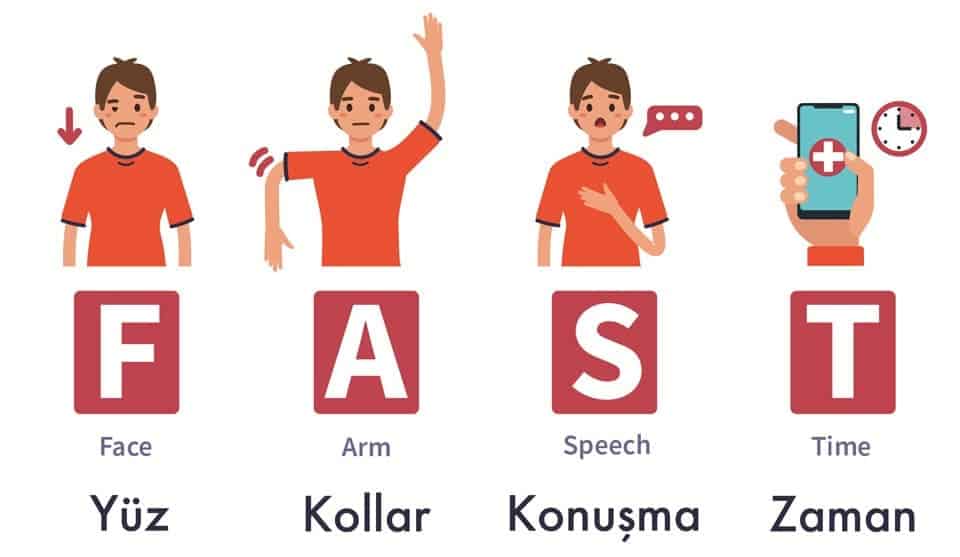
- Face: Ask the person to smile. Check if one-half of the face stands numb. Dropping of the face, drooping of one half of the face, or dripping of saliva from the side of the mouth are symptoms of a stroke.
- Arms: Ask the person to raise both arms. One of the arms stays down? Weakening of arms or legs, being unable to hold something, being unable to lift the leg, sudden numbness of arms or legs, feeling as if our arms or legs do not belong to us are symptoms of a stroke.
- Speech: Ask the person to say one small sentence. Is he or she having a lisp or speaking oddly? Speech disorder, sudden change in speech, twisting of the tongue, and speaking incomprehensively are symptoms of a stroke.
- Time: If you are experiencing any of these symptoms call 112 without losing any time.
2. What are the symptoms of a stroke? What are the indicators that signal a stroke?
Sometimes a stroke makes its way gradually not suddenly. In case of any existing symptoms listed under call 112:
- Numbness in the face, arms or legs, one half of the body, sensory loss or weakness.
- Confusion inability to understand other people
- Difficulty speaking and/or swallowing
- Sudden loss of vision, visual impairment in one or both eyes
- Problem walking and balancing
- Sudden and severe headache that started without reason
- Loss of consciousness, sudden falls, black-outs
- Ignoring one side of the body
- Urine incontinence
In patients who experienced a stroke, unwanted situations like spasms in the arms and legs, shoulder aches, depression, infection, epilepsy, neuropathic pain can emerge in the future.


Dr. Engin Çakar
Our Treatments
Contact us
Phone
+90 542 215 80 80
Email
Let Us Call You
You can easily reach us by filling out the contact form. Our team will call you shortly to inform you.
Frequently Asked Questions
Stroke-related paralysis symptoms include facial asymmetry, sudden numbness or weakness in the arm or leg (especially on one side of the body), sudden difficulty speaking, sudden walking or balance problems, sudden severe headache, and vision disturbances. These symptoms may result from cerebral vascular occlusion or brain hemorrhage. If any of them appears suddenly, call emergency services immediately.
Apply the Face-Arm-Speech test: ask the person to smile (is there facial drooping?), ask them to raise both arms (does one drop?), and ask them to repeat a simple sentence (is speech slurred?). If any issue is found, call emergency services immediately.
Call emergency services immediately. Lay the patient down with the head slightly elevated. If vomiting, turn them to the side position. Note the time symptoms started; the golden window for thrombolytic therapy is the first 4.5 hours. Do not give anything by mouth. If cardiac or respiratory arrest occurs, basic first aid (CPR) should be applied.
Yes, a transient ischemic attack (TIA) — a temporary blockage of cerebral vessels — can be a warning. Symptoms are the same as stroke but resolve within minutes to hours. The risk of a real stroke rises markedly within the first 48 hours and during the first week after a TIA, making urgent evaluation essential. Even temporary symptoms should be taken seriously and medical attention should be sought immediately.
In a stroke caused by cerebral vascular occlusion or brain hemorrhage, partial paralysis (hemiparesis — partial paralysis of one side of the body) means partial weakness; the patient can still partly use the affected side. Complete paralysis (hemiplegia — total paralysis of one side of the body) means a total loss of movement. The potential for recovery is higher in partial paralysis. Early physical therapy and rehabilitation, particularly comprehensive personalized neurorehabilitation, is critical in both cases.